THE BRIMBORDION BALDERDASH CLAPTRAP

May you be afflated with asseveration through this éclaircissement and crescive demiurge. Pursue alethiology to bring about acatalepsy, for the holy writ is an accretion about acatalepsy. Having this assuetude will anteambulo you to light. It is through the assuefaction of asceticism, betwixt the deontic of equanimity, that enlightenment is attained. The astriction to abnegate our ablepsia is to abnegate antinomianism. Eke, in our durative asceticism, we strive to be the apograph of Christ or our apocatastasis, equative of the Deity.

This amphigory, in its similitude to amplexus, reveals that all transforms to a cack. Let this blateration cease, for it must not bajulate souls who are already enduring spiritual abasia. One’s bionergy does not gain a zenzizenzizenzic ability or power to abraise the soul through deception. This is pure razzmatazz. Let us not render Agape abyssopelagic or make ourselves mere clanging cymbals, but instead, clepe the soothfast yeme of Agape.

Life is really simple, but we insist on making it complicated.

Confucius

“One should use common words to say uncommon things”

Arthur Schopenhauer

“The role of genius is not to complicate the simple, but to simplify the complicated.”― Criss Jami, 

“I am not a genius, I am just curious. I ask many questions, and when the answer is simple, then God is answering.”

Albert Einstein

Luke 24:45 Then He opened their minds to understand the Scriptures,

Psalms 119:129, 130 Your testimonies are wonderful: therefore does my soul keep them. The entrance of your words gives light; it gives understanding to the simple.

When I testify of God or quote His words, are my words simple and does the listening soul understand and keep them?

Vocabulary

acatalepsythe unknowableness of all things to a certainty
accretionaccumulation; addition of parts to form a whole
afflatedinspired
afflatusinspiration; divine impetus
alethiologystudy of truth
anteambulousher
apocatastisisreversion or restoration to original position
apographexact copy; facsimile
ascesisthe practice of disciplining oneself; asceticism
asseverationpositive or earnest affirmation
assuefactionhabituation
assuetudeaccustomedness; habit
astrictionbinding obligation
betwixtbetween
bionergyvital essence or force
crescivegrowing; increasing
demiurgecreative spirit or entity
deonticof or relating to duty or obligation
durativecontinuing; not completed; undergoing transformation
dureto last; to endure
éclaircissementclarification; enlightenment
ekein addition; also; likewise
equanimityevenness of mind or temper; calmness
equativeindicating likeness or identity
accumulationaddition of parts to form a whole inspired
antinomianismdoctrine of the rejection of moral law
amplexusrutting of frogs and toads
zenzizenzizenziceighth power of a number
clepeto call, name, or summon
soothfasttrue, faithful, or genuine
yemecare, guardianship, or protection
Agape.Divine love

CHANGES

There is no other period of time where changes have occurred as fast as human can adapt.

How should you be ready to change?

To be ready for change, youth can benefit from developing the following skills and qualities:

  1. Flexibility: Being open to new experiences and adaptable to different situations.

  2. Critical thinking: Analyzing information and evaluating different options to make informed decisions.

  3. Resilience: Being able to bounce back from challenges and setbacks.

  4. Self-awareness: Understanding one’s strengths, weaknesses, values, and goals.

  5. Communication: Being able to express thoughts and ideas effectively and listen actively to others.

  6. Problem-solving: Developing the skills to identify and overcome obstacles.

  7. Teamwork: Working collaboratively with others to achieve a common goal.

  8. Emotional intelligence: Being able to manage emotions and relate to others in a positive way.

  9. Continuous learning: Staying curious and open-minded, and continuously seeking out new knowledge and experiences.

Responsibility: Taking ownership of one’s actions and being accountable for the consequences.

CHANCES

There is no other period of man where freedom is a challenge and taking a chance is ever harder because the doubt is stronger.

How should the youth take chances in life?

To take chances in life, youth can benefit from following these steps:

  1. Assess the risk: Consider the potential outcomes and weigh the pros and cons.

  2. Set achievable goals: Clearly define what you hope to achieve and create a plan for reaching your goals.

  3. Seek advice: Talk to trusted individuals such as parents, teachers, or mentors for guidance and support.

  4. Be prepared: Take the necessary steps to minimize the risks and increase the chances of success.

  5. Take calculated risks: Make informed decisions and act boldly, but be mindful of the consequences of your actions.

  6. Learn from failure: Use failures as opportunities to learn and grow, and do not be discouraged by setbacks.

  7. Stay positive: Maintain a positive outlook and focus on the opportunities rather than the challenges.

  8. Stay flexible: Be open to new experiences and be willing to change direction if necessary.

  9. Celebrate successes: Recognize and celebrate your accomplishments, no matter how small they may seem.

  10. Keep trying: Don’t be afraid to take chances and keep pushing yourself to reach your full potential.

CHOICES

There no period in the era of human where there isn’t an overwhelming choice offered to man? Below are the list of choices we make in life.

Here are some common choices that people make in life:

  1. Career choices: What profession to pursue, what job to take, and what industry to work in.

  2. Educational choices: What subjects to study, what school to attend, and what degree to earn.

  3. Relationship choices: Who to date, who to marry, and how to interact with friends and family.

  4. Financial choices: How to manage money, how to save and invest, and how to plan for retirement.

  5. Health choices: What to eat, how to exercise, and how to take care of one’s physical and mental health.

  6. Lifestyle choices: Where to live, how to spend free time, and what hobbies to pursue.

  7. Political choices: What causes to support, who to vote for, and how to participate in the political process.

  8. Personal growth choices: What personal goals to set, what skills to develop, and how to handle challenges and setbacks.

It’s important to keep in mind that every choice has consequences, and it’s up to each person to make choices that align with their values and lead to a fulfilling life.

How should one make wise and right choices in life?

To make wise and right choices in life, youth can benefit from following these steps:

  1. Know yourself: Understand your values, strengths, weaknesses, and goals.

  2. Gather information: Seek out relevant information, consider multiple perspectives, and make informed decisions.

  3. Consider the consequences: Think about the potential outcomes of your actions and how they will affect you and others.

  4. Seek advice: Talk to trusted individuals such as parents, teachers, or mentors for guidance and support.

  5. Practice mindfulness: Be aware of your thoughts and emotions, and make decisions based on reason and not just impulse.

  6. Use critical thinking: Analyze the situation, weigh the pros and cons, and make an informed decision.

  7. Take responsibility: Be accountable for your decisions and take ownership of the consequences.

  8. Stay open-minded: Be willing to consider new ideas and perspectives, even if they challenge your own beliefs.

  9. Set achievable goals: Clearly define what you hope to achieve and create a plan for reaching your goals.

  10. Seek guidance: Seek guidance from a higher power or spiritual practice, if that is a part of your belief system.

How should you be able to wisely take right choices in life?

To make wise choices in life, youth can benefit from following these steps:

  1. Know your values and priorities: Clearly understand what is important to you and what you want to achieve in life. Check you values here: https://interacty.me/projects/15505d909d21a4fc

  2. Gather information: Seek out relevant information and consider multiple perspectives.

  3. Consider the consequences: Think about the potential outcomes of your actions and how they will affect you and others.

  4. Get advice: Seek guidance from trusted individuals such as parents, teachers, or mentors.

  5. Reflect on your emotions: Be aware of your feelings and how they may influence your decisions.

  6. Use critical thinking: Analyze the situation, weigh the pros and cons, and make an informed decision.

  7. Take responsibility: Be accountable for your decisions and take ownership of the consequences.

  8. Stay open-minded: Be willing to consider new ideas and perspectives, even if they challenge your own beliefs.

  9. Practice self-reflection: Regularly assess your choices and learn from your experiences.

  10. Seek guidance: Seek guidance from a Higher Power or spiritual practice, if that is a part of your belief system.

I hope this simple guide helps you prepare for making important life decisions with greater clarity and confidence.

Be At It Too

Imagine you’re on a sailboat in the middle of the ocean, but you have no rudder to steer. Without it, you’re completely at the mercy of the wind and waves. You can’t control where you’re going, and no matter how hard you try, the wind pushes you wherever it wants. The waves toss you around, and you can’t keep the boat on course. It’s like trying to walk a straight line on a slippery slope—you just keep sliding off track.

As the wind and waves get stronger, your boat might start turning sideways to the waves, making it even harder to stay upright. You feel the boat tipping dangerously, and you realize that without control, you’re at risk of capsizing. The fear of drifting into dangerous waters or getting swept far out to sea grows stronger. It’s a lot like life without direction. Without a clear sense of purpose or guidance, you can easily be swept away by whatever comes your way, losing sight of where you want to go. Having control is essential, whether you’re navigating a sailboat or steering your life.

You Are God’s Special Child

First let us count what the Intelligent Being as many called God has installed in your body.

The human body is made up of approximately 37.2 trillion cells.

An adult human has 206 bones. However, at birth, the body has about 270 bones, many of which fuse together as we age.

The total length of nerves in the human body is about 45 miles (72 kilometers). The sciatic nerve is the longest, stretching from the lower back down to the feet.

If you were to stretch out all the blood vessels in the human body, they would cover approximately 60,000 miles (100,000 kilometers).

The skin, the largest organ, covers an area of about 22 square feet (2 square meters) in an average adult.

The human body contains over 600 muscles. The smallest is the stapedius muscle in the ear, and the largest is the gluteus maximus (the buttock muscle).

The average human heart beats about 100,000 times per day, pumping roughly 2,000 gallons (7,570 liters) of blood daily.

The total lung capacity of an average adult human is about 6 liters of air.

The entire digestive system, from mouth to anus, is around 30 feet (9 meters) long.

The human brain weighs approximately 3 pounds (1.4 kilograms) and contains about 86 billion neurons.

On average, human hair grows about half an inch (1.25 cm) per month.

The average person blinks about 15-20 times per minute, which totals approximately 28,800 blinks per day.

Adults typically have 32 teeth, including wisdom teeth.

The human body produces around 2 million red blood cells every second.

The human nose can detect about 1 trillion different scents.

If all the DNA in your body’s cells were stretched out end to end, it would span approximately 67 billion miles (108 billion kilometers)—enough to reach from Earth to Pluto and back more than 10 times.

The average human tongue has about 2,000 to 8,000 taste buds, each containing 50-100 taste receptor cells.

The human body is composed of approximately 60% water. The brain and heart are around 73% water, and the lungs are about 83% water.

The human body has between 2 million to 4 million sweat glands. The highest concentration is on the soles of the feet, palms, forehead, and armpits.

Fingernails grow about 3.5 millimeters per month, while toenails grow at roughly half that rate.

The average adult has about 1.2 to 1.5 gallons (4.5 to 5.5 liters) of blood circulating through their body.

The average normal body temperature is about 98.6°F (37°C), but it can vary slightly from person to person.

The human body has around 360 joints, though the exact number can vary depending on how one defines a “joint.”

Human bones are about 5 times stronger than steel of the same density. However, they are also much lighter and more flexible.

The average human scalp has about 100,000 to 150,000 hair follicles. People with blonde hair typically have more hair follicles than those with dark hair.

Each blink lasts about 1/10th of a second, and the average person blinks around 15-20 times per minute.

The human skin completely renews itself about every 27 days. This means that in a year, you will shed around 9 pounds (4 kilograms) of dead skin cells.

The liver is the largest internal organ, weighing around 3.5 pounds (1.6 kilograms). It performs over 500 vital functions, including detoxification and protein synthesis.

The stapes, a bone in the middle ear, is the smallest bone in the human body, measuring about 3 millimeters in length.

The heart is powerful enough to squirt blood up to 30 feet (9 meters) in the air when it’s pumping at full force.

The human brain’s memory capacity is believed to be around 2.5 petabytes, or a million gigabytes, which is roughly equivalent to 3 million hours of TV shows.

The human brain has about 86 billion neurons, each connected to thousands of other neurons, creating a vast and complex network.

Red blood cells have a lifespan of about 120 days, after which they are broken down and recycled by the body.

The human body has about 500 to 700 lymph nodes, which are crucial for filtering harmful substances and fighting infections.

The gluteus maximus, located in the buttocks, is the largest muscle in the human body.

The orbicularis oculi, the muscle around the eye, is the fastest muscle in the body, allowing you to blink in an instant.

Despite accounting for only about 2% of body weight, the brain uses approximately 20% of the body’s total energy.

The small intestine is about 20 feet (6 meters) long, while the large intestine is about 5 feet (1.5 meters) long.

The human body has more than 30 muscles in each hand that allow for complex movements and dexterity.

The body produces 1 to 2 grams of earwax per month, which helps protect and clean the ear canal.

What do you think of yourself now?

Now, rediscover who you are in God. Perhaps you’ve been listening to too many voices that aren’t God’s. Perhaps your eyes have been drawn to things you’ve envied and desired, causing you to lose sight of your true identity. Maybe you’ve noticed that all your efforts to find fulfillment seem in vain, leading you away from your true purpose in life. Perhaps you’ve been searching in so many places, hoping to find your true self, only to end up trying to be someone you’re not. It might be time to stop and listen to who you really are according to what has been Written about you.

My True Identity In Christ Jesus

At some point in life, we all seek our identity. Many of us dislike aspects of ourselves—how we look, the sound of our voice, or the way we are. We envy others’ beauty, physique, status, or success. We feel jealousy and bitterness, and this can lead us to self-hate.

In our efforts to fight these perceived inadequacies, we continually compare ourselves to others. We desire what others have and convince ourselves that we must have it too. This relentless pursuit to outshine others, to be noticed, to be famous, to be liked, and to be loved, drives us to the top of the list. But are you in a competition? Have you forgotten who you truly are? For centuries, humanity has been misled into believing that outward appearance is the true measure of a person. But that’s never true. Our bodies fade, age, deteriorate, get sick, and eventually return to dust.

What do you want others to say about you? How would you like to be remembered when you die? Pause and see your true self in Christ Jesus—your true identity. You have been given so much, and nothing can take that away from you. Look in the mirror, read this message out loud to yourself, and live as God designed you to be.

Below is the list of who you are in Christ Jesus.

If you find this a blessing, go and share that others may find their true identity.

You Are The Faith

Faith is never something we need to seek or chase after, because it is never distant from us. Faith is not an amulet or talisman, something we wear for power or protection. Faith is not a magic wand that you brandish to ward off bad situations. Faith is not an emotional ride, where your feelings dictate your fate. Faith is not a detergent to cleanse away evil spirits. Faith is something implanted by God within you. It is a built-in divine application that, when activated, accomplishes what you once thought was impossible. A phone remains just a phone without software applications. Only when you activate these applications does your phone become smart and powerful. Activate the faith within you, and witness the wonders it can bring to your life.

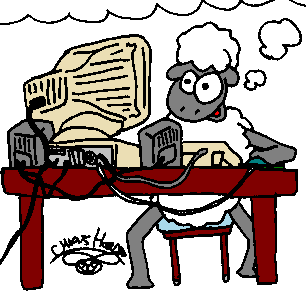
THE E-GADGET IS MY SHEPHERD

The E-Gadget is my shepherd, my spiritual life shall not want. It makes me to sit down and do nothing for His name sake, because it requires my spare time. It keeps me from doing my duty as a Christian, because it presents so many info that I must see.

It restores my knowledge of the things of the world and keeps me from the studying God’s word. It leads me not to evening worship services and doing nothing for the Kingdom of God.

Yea, though I live to be a hundred years I shall be viewing my E-Gadget as long as it works. For it is my closest companion, its sound, its picture, they comfort me.

It presents entertainment before me and keeps me from doing important things with my family. It fills my head with ideas, which differ from those set forth in the Word of God.

Surely, no good things will come into my life, because my E-Gadget offers no good time to doing the will of God. With this I will dwell in the place of the devil and his angels forever.

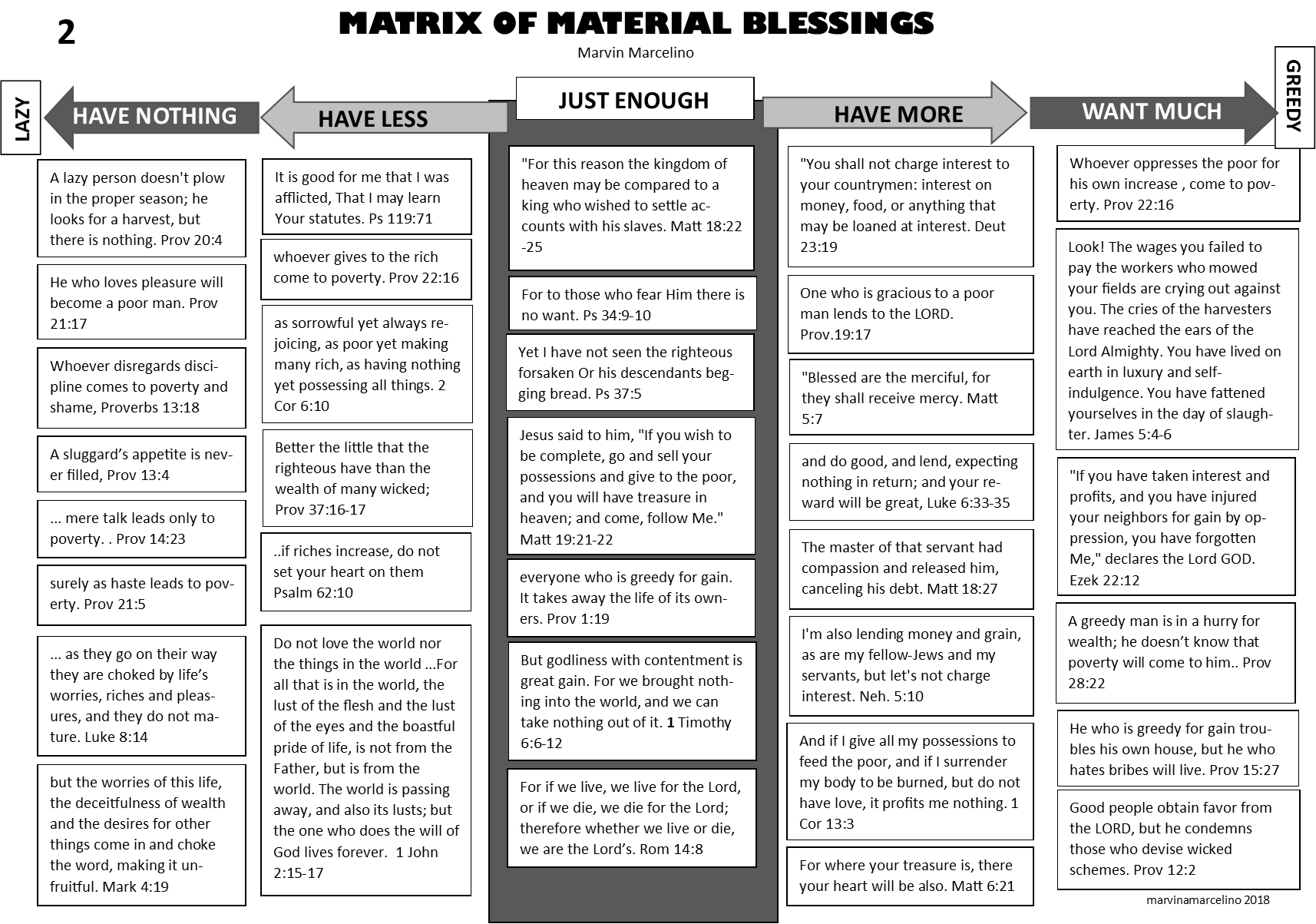
MATRIX OF MATERIAL BLESSINGS: Money Talks

Money often sparks conflicts, stirring tensions within families, between neighbors, among communities, in businesses, within governments, and even on the global stage. On its own, money isn’t inherently bad; it’s the way people interact with it that makes all the difference. The real issue lies with us humans: when greed creeps in and contentment fades away, trouble brews. This trouble takes the shape of envy and jealousy, feeding into more conflict and strife among us. Remember, money itself isn’t the problem; it’s the love and greed for money that lead to trouble.

Now, let’s talk about money itself. It’s a tangible thing, something you can hold and spend. Some folks have a little or none at all, while others seem to have more than they know what to do with. Take a moment to think about where you stand: if you’re on the lower end, lean left; if you’re craving more, lean right. Below, you’ll see a chart illustrating material wealth. Let’s follow the advice from the Holy Writ and aim to find contentment with what we have.

The issue of money seems to keep popping up time and again among us. You know what they say about repeating problems, right? It’s like that old saying about insanity: doing the same thing over and over and expecting different results. It’s like intelligence takes a back seat or something.

And you know what? It’s kinda like addiction, too. The addict just can’t get enough, always craving more, while the dealer is right there, ready to profit off someone else’s struggles. It’s like a vicious cycle.

But you know what really gets me? A lot of times, poverty and tough times are blamed on laziness. Sure, there are some folks who might not put in the effort, but there are also those who take advantage of someone else’s tough luck for their own gain. And that’s where greed comes into play. It’s like a never-ending cycle of taking advantage of others’ misfortune.

I hoped you find yourself in the matrix and change if you need to be and live contented and have peace of mindful.